Unlocking Non-Verbal Communication: AAC, PECS, and ABA for Autistic Children
As a Board Certified Behavior Analyst and mother of an autistic young adult, I know how many parents in Oakville, Mississauga, and Brampton sit in that same quiet room right now. Augmentative and Alternative Communication (AAC) is not a last resort; it is one of the most powerful tools to give a child a voice before frustration turns into behaviour.
Quick Summary:
- AAC includes low-tech (PECS, communication boards) and high-tech (speech-generating devices, apps) options that support any level of verbal ability
- PECS is a research-backed picture exchange system taught through behavioural principles by BCBAs or speech-language pathologists
- Using AAC does not delay speech — research consistently shows it supports and can accelerate verbal development
- Ontario families can access AAC funding through the Ontario Autism Program (OAP) and the Assistive Devices Program (ADP)
Our OAP in 2026 guide covers how to use Core Clinical Services funding for AAC devices and therapy.
1. What Is AAC and Why Every Parent Should Know About It
Augmentative and Alternative Communication (AAC) refers to any method a person uses to communicate when spoken words are insufficient or absent. For an autistic child who is minimally verbal or non-speaking, AAC is not a sign that therapy has failed — it is the bridge that prevents isolation. If frustration from lack of communication turns into behaviour, our guide on Autism Meltdowns vs. Tantrums explains why understanding the root cause changes everything about how you respond.
AAC can also affect mealtime — many non-verbal children struggle with food aversions because they cannot express what they like or dislike. Our guide on Picky Eating and Food Aversions in Autism covers feeding strategies that complement AAC use.
AAC falls into two categories. Low-tech AAC includes picture exchange systems like PECS, printed communication boards with symbols, and simple choice cards — no batteries required, usable anywhere from a Burlington grocery store to a Milton playground. High-tech AAC involves speech-generating devices (SGDs) like iPads running apps such as Proloquo2Go or LAMP Words for Life, storing thousands of words that grow with the child.
The critical thing parents in the Western GTA need to understand is this: AAC is not either/or. A child might use PECS at home while using a speech-generating device at school. The best AAC plan is flexible and embedded into daily routines — not confined to therapy sessions alone.
2. How PECS Works Through Its Six Phases
The Picture Exchange Communication System (PECS) was developed by Andy Bondy and Lori Frost and is one of the most extensively researched AAC approaches for autism. It teaches communication through six progressive phases, typically delivered by a trained BCBA or speech-language pathologist (SLP).
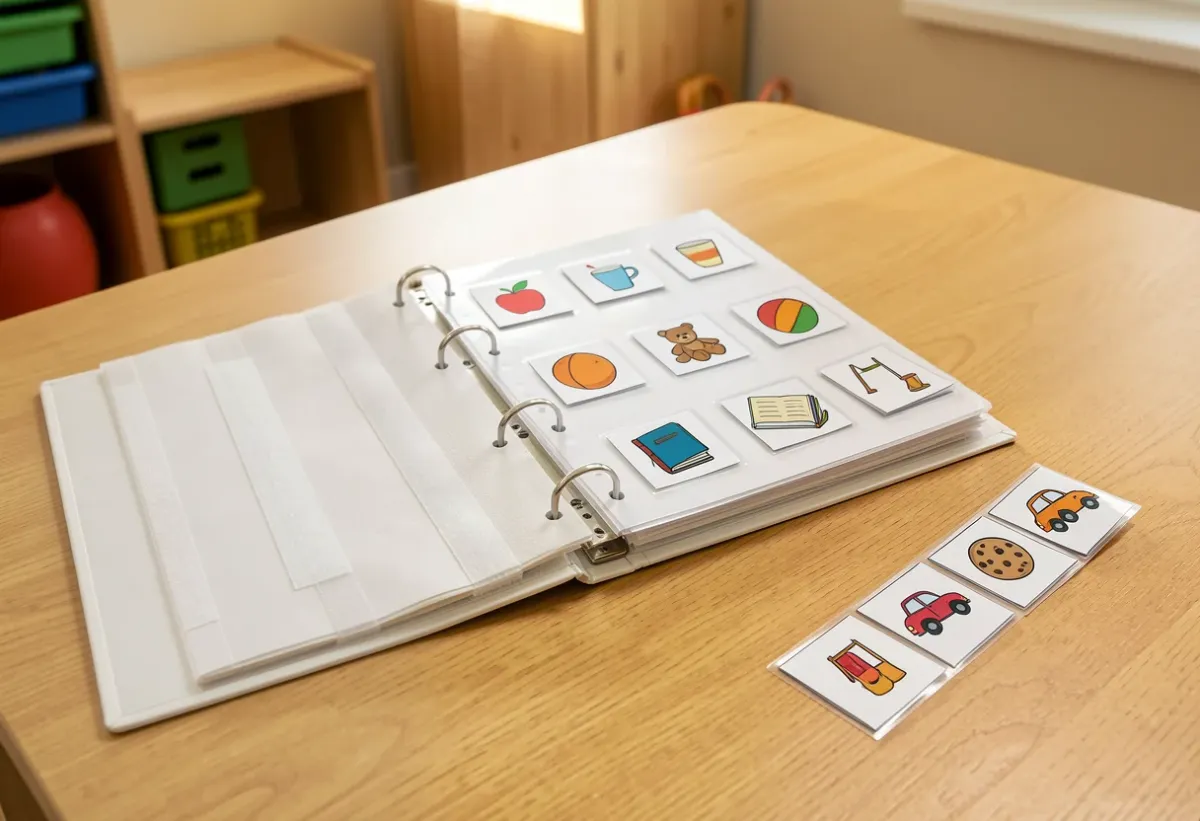
Phase I teaches the physical exchange: initiating communication by picking up a picture of a desired item and handing it to a communicative partner in exchange for the item. Phase II builds distance and persistence: traveling across a room to reach the partner and retrieving pictures from a communication binder. Phase III introduces picture discrimination: choosing between two or more symbols (first between a preferred and non-preferred item, then between multiple preferred items) in the communication book.
Phase IV teaches sentence structure: constructing multi-word requests on a detachable Sentence Strip using an "I want" symbol followed by the picture of the target item, and handing the entire strip to the partner. Descriptors and attributes (e.g., color, size, quantity like "big cookie") are also introduced during this phase to expand expressive vocabulary. Phase V teaches responding to direct questions like "What do you want?" using the Sentence Strip, while Phase VI expands beyond requests into responsive and spontaneous commenting: expressing "I see...", "I hear...", or "It is..." when interacting with the environment.
At Xable, we integrate PECS principles into ABA therapy because the behavioural foundation aligns directly with how we teach functional communication skills. If you want to understand our broader approach to evidence-based intervention, see Understanding Modern ABA Therapy. When a child learns that communication works — their message produces a reliable result — everything else becomes possible.
3. AAC Devices and Apps Available in 2026
The landscape of high-tech AAC has expanded dramatically with costs lowered by provincial funding programs. Proloquo2Go remains one of the most popular iPad-based apps, using a visual grid layout with core vocabulary words always accessible. TouchChat HD offers similar functionality with a larger built-in vocabulary, while LAMP Words for Life uses a consistent keyboard layout where word positions never change — helping children develop muscle memory for communication.
The key is matching the tool to the child's profile. A speech-language pathologist assessment through AccessOAP-referred services in the Western GTA can help determine which approach fits best. If you are unsure whether your child needs ABA, speech therapy, or occupational therapy (or all three), ABA vs. Speech Therapy vs. Occupational Therapy walks through how each discipline contributes to a comprehensive AAC plan.
4. The Research: Does AAC Delay Speech or Help It?
This is the most common question I hear from parents — and it is one of the most thoroughly answered by research. AAC does not delay speech. It supports and often accelerates verbal development. Multiple peer-reviewed studies show that children who use AAC alongside traditional therapy equal or exceed gains in spoken language compared to speech therapy alone.
The reason is straightforward: AAC reduces the frustration gap between what a child wants to say and what they can physically produce. When frustration drops, motivation increases — and practice naturally builds verbal skills over time. I have seen this firsthand with my own son and with dozens of children in clinical practice. Choosing AAC is not closing a door on speech; it is opening a window that lets communication happen right now while speech develops at its own pace.
5. How Xable Supports Non-Verbal Communication in the Western GTA
At Xable, we work with non-verbal children across Oakville, Mississauga, Brampton, Milton, and Burlington every day. Our approach integrates AAC into ABA therapy from the very first session — communication is not something a child earns after reaching other milestones; it is their right and the foundation for everything else.
Our Registered Behaviour Analysts (R.B.A. Ont.), BCBAs, and clinical therapist teams are trained in PECS implementation, core vocabulary teaching, and modelled AAC use (therapists consistently use their own devices during interactions so the child sees communication as a two-way street). We coordinate with external speech-language pathologists to ensure ABA and SLP goals reinforce each other. And we help families navigate OAP funding applications for AAC-related services and devices.
Start Giving Your Child a Voice Today
Every child deserves to be heard — regardless of whether their voice comes through spoken words, pictures, buttons, or a speech-generating device. If you are in the Western GTA and want to explore how AAC can support your child's communication journey, the Xable team is here to talk it through — we will listen, assess, and help you build a plan that gives your child the tools they need.
Contact Xable
- Phone: (289) 430-5730
- Email: info@xable.ca
- Website: xable.ca

Afsheen Sheikh
Managing Director & Behaviour Consultant | M.Sc., M.B.A., B.C.B.A., R.B.A. (Ont.)
Afsheen’s journey into special needs therapy began over 20 years ago following her son's autism diagnosis. Combining personal parent perspective with extensive clinical practice, she provides evidence-based, compassionate, and neurodiversity-affirming care for families across Mississauga, Oakville, Brampton, Milton, Burlington, and Etobicoke.
Navigating the Ontario Autism Program?
Get personalized support for OAP funding allocations, ABA/IBI therapy, speech-language therapy, and life skills programs across Mississauga, Oakville, Brampton, Milton, Burlington, and Etobicoke.
Related Articles

ABA vs. Speech Therapy vs. Occupational Therapy: Which Does Your Child Need?
Understand the key differences between ABA, Speech Therapy (SLP), and Occupational Therapy (OT), and how a multidisciplinary approach helps your child.

How to Understand Skill Tags in Ontario Autism Program Funding
What OAP skill tags actually are, how they set your child's funding tier, and how to make sure their needs are captured.

How to Prepare for the Ontario Autism Program (OAP) Determination of Needs (DoN) Interview
A step-by-step guide to preparing for your AccessOAP Determination of Needs interview: what to expect, how to document needs, and how funding is set.